
I offer clinical supervision in Hornchurch, Essex for counsellors and trainee therapists. My aim is to provide a safe, supportive and reflective space where you can explore your client work, develop your practice and maintain ethical standards.
Choosing a supervisor is an important decision. Supervision should be somewhere you feel supported, appropriately challenged and able to bring your whole self and your client work into the room.
Clinical supervision is an important part of being a counsellor. As counsellors, supervision is vital that we have a good support system in place for our professional and confidential work. Having a safe space to process is important.
Qualifications and experience
I am an accredited Integrative Counsellor and qualified Clinical Supervisor. I have qualified as a counsellor in 2017 and have been practising as a Clinical Supervisor since 2022. Holding a Level 6 Advanced Certificate in Clinical Supervision, including face-to-face, online, and telephone supervision. I am a member of the BACP and NCPS, with over 9 years experience working in private practice.
Offering you my experience, passion and thirst of knowledge about anything about the counselling world. In my busy private practice, I offer my clients a flexible working model to fit my clients needs and I offer you the same. I am able to offer you supervision in person, online or telephone.
Supervisors can take you to incredible heights. They help you to fly, providing the wind beneath you and provide you with a net if you fall.
As an integrative therapist I use a number of theories. When working with a client depending on the issues that present because my belief is every client is different so I am able to adapt my approach to the individual. I have experience with working with Employee Assistance Programmes (EAPS) such as Retail Trust, HelpEAP, Organisations including Victim Support and I am a BUPA recognised healthcare professional.
My goal is to provide you a safe, non judgmental, warm environment for you, to explore your thoughts and feelings around your client work. I am aware that being open, vulnerable in your supervision can be extremely difficult. Bringing all of your complicated, messy and shadowy feelings out in the open takes courage, but will help you to make your practice better. Through working together I can support you to support your clients.
Supervision is about supporting you as a person and your client work.
Supervision Isn’t About Having All the Answers
For me, good supervision isn’t about sitting opposite someone who has all the answers.
It’s about having somewhere you can bring the messy bits too.
The client you can’t stop thinking about.
The session you wish you’d handled differently.
The personal stuff that might be affecting your capacity.
The self-doubt, imposter syndrome and uncertainty.
The mistakes, the successes and the moments when you genuinely don’t know what to do next.
I want you to feel able to say:
“I’m struggling with this.”
“I think I got this wrong.”
Or even:
“I have absolutely no idea what I’m doing here.”
…without worrying that I’m going to judge you.
Of course, I’ll challenge you when needed. That’s an important part of good supervision. But I believe that challenge should come from a place of support, curiosity and a genuine desire to help you develop.
Sometimes we reflect deeply, Sometimes we challenge things, Sometimes we swear and sometimes we laugh unapologetically.
Supervision can involve incredibly difficult and serious work, but I don’t believe the supervision room always has to feel serious.
I’m human. I’m authentic. I definitely don’t have all the answers, and I’m still learning too.
I want my supervisees to feel that they can be human too.
Why is Supervision Important?
As counsellors, we are human too.
We listen to difficult and sometimes traumatic experiences, and naturally, some of what we hear can stay with us. We also have our own lives, and sometimes personal experiences can affect our capacity or responses within our client work.
This is why having a safe and trusted supervision space is so important.
Supervision gives us somewhere to pause, reflect and explore what may be happening within ourselves, our clients and the therapeutic relationship.
You may feel stuck with a client, unusually protective, frustrated or emotionally affected by their story. You might notice something from your own life resonating with their experience or recognise a parallel process developing.
These are exactly the things we can bring to supervision.
By exploring them without judgement, we can gain perspective, recognise blind spots, maintain appropriate boundaries and continue to work safely and effectively with our clients.
I know from my own experience how valuable it can be to bring something that has stayed with you into supervision. Having space to explore it can offer a different perspective, help you understand your response and allow you to return to your client work feeling more grounded and clearer about what your client may need.
Supervision isn’t personal therapy, but it recognises that the counsellor is part of the therapeutic process too.
For me, that’s an important part of supervision. Supporting you as a person, so you can continue to support your clients.
Supporting You Throughout Your Counselling Journey
I welcome you at whatever stage you are at in your counselling journey.
Whether you are just starting out as a student counsellor on placement, newly qualified, working within an organisation or developing your own private practice, I can offer supervision that supports you to build confidence, reflect on your work and develop your professional identity.
Supporting Student Counsellors
Starting a placement can feel both exciting and daunting. There is so much to learn as you begin working with clients, develop your counselling skills and find your own way of practising.
I offer a safe and encouraging space where you can ask questions, explore your experiences, reflect on your client work and build confidence in your developing skills.
Supporting Private Practice
If you are newly qualified or thinking about setting up your own private practice, I can offer more than clinical supervision.
I understand that establishing a private practice can feel overwhelming. Alongside supervision, I can support you to think about how you want your practice to look and feel, develop your professional identity and navigate some of the challenges that come with working for yourself.
My aim is to help you build a practice that reflects your values, your way of working and the kind of counsellor you want to be.
Supporting Your Professional Development
If you are working towards accreditation, I can also support you with your application.
As a BACP accredited counsellor and Senior Accredited counsellor with the NCPS, I can offer guidance throughout the accreditation process, including supporting you with the required report for the professional body you are applying to.
A Space to Reflect
For me, supervision is about creating a space where you feel supported, heard and able to bring whatever is on your mind, whether that’s challenges, insights, questions or those moments that stay with you after a session.
I know how valuable it is to have somewhere you can reflect openly, without pressure or judgement.
We both want our clients to feel calm, respected and heard. Just as you aim to give your clients autonomy and acceptance, I want to offer you that same sense of respect within our supervisory relationship.
Supervision sessions are private and confidential within the boundaries of the ethical and professional frameworks that guide our work.
My approach
I am an eclectic integrative counsellor I use the theories of Person centred, CBT, Psychodynamics, TA and Creative counselling.
I map my supervision to the BACP and NCPS ethical frameworks.
Finding the right supervisor for your practice can feel daunting to find the best fit for your work. My aim is to be able to offer you a safe and supportive space. To collaborate on focusing on your client work and to encourage your personal growth and development. My aim is to strengthening your client work to empower you and your clients.
As a clinical supervisor I use the Seven Eyed Model and IDM. Putting you and your clients in the focus of working on the relationships between you, your clients and our relationship. We will take into consideration the things happening between each relationship. Plus the wider system for your client and their needs.
3 Main areas of Supervision
Clinical Supervision falls into three main areas, with ethics always being in the forefront of both the supervisors and counsellors mind:
Formative – Growth-based
Formative supervision focuses on your learning and development as a counsellor. It’s a space where you can deepen your understanding, grow your skills, and begin to shape your own way of working.
Normative – Monitoring-based
The normative aspect of supervision is not about criticism or fault-finding. Instead, it offers a steady and reliable structure. Supporting you to practise safely, build accountability, and develop confidence in your professional judgement linked to ethical guidelines.
This aspect of supervision is about learning through reflection and experience. Helping you to feel more grounded, capable, and assured in your practice.
Restorative – Support-based
Restorative supervision focuses on your wellbeing and emotional resilience as a counsellor. The work you’re doing can be deeply affecting, and this space allows you to pause, process, and reconnect with yourself.
This aspect of supervision is about care as much as competence. Recognising that looking after yourself is an essential part of becoming a safe and effective therapist.
Clinical Supervision is not the place for the counsellor to obtain their own therapy, although sometimes issues in a counsellor’s life might impact on their ability to give full attention to the client.
I map my supervision to the BACP, NCPS ethical frameworks.
Finding the right supervisor for your practice can feel daunting to find the best fit for your work. My aim is to be able to offer you a safe and supportive space. To collaborate on focusing on your client work and to encourage your personal growth and development. My aim is to strengthening your client work to empower you and your clients.
Seven Eyed Model
I specifically work in general with the seven eyed model of supervision:
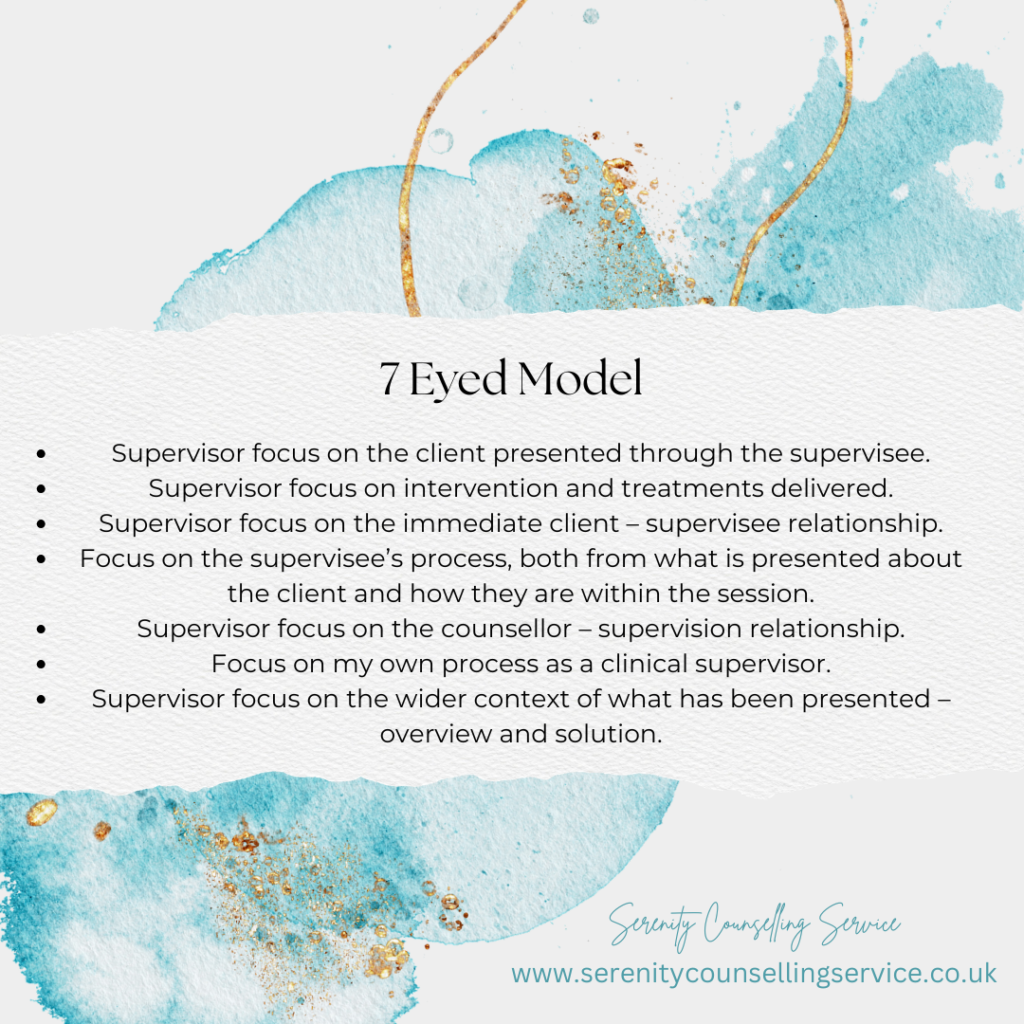
Eye one: The Client
Focusing on the client presented through the supervises prospective. The focus is on the client’s story, how they present, and their internal experience.
Eye two: The Interventions
Looking at the interventions and treatments delivered. exploring what has worked and what can be used in the future sessions.
Eye three: The Client Counsellor Relationship
Supervisor focus on the immediate client – focusing on the supervises relationship with their client. Exploring the relationship dynamic between the client and counsellor, this can include transference and countertransference.
Eye four: The Counsellors Internal Process
Focussing on the supervisee’s internal process. Focuses on the supervisee’s own experience, emotions, and reactions.
Eye five: The Supervisory Relationship
Focusing on the Supervisory Relationship Supervisor reflecting on what is occurring between the supervisor and the supervisee.
Eye six: The Supervisor’s Internal Process
The supervisor examines their own inner experiences, thoughts, and feelings during the session. Focusing on my own process as a clinical supervisor.
Eye seven: The Wider Context
Supervisor focus on the wider context of what has been presented. Looking at an overview and solution addressing the broader context and system looking at the organisational, cultural, or systemic issues affecting the client work.
Counselling Supervision is a formal and mutually agreed arrangement for counsellors to discuss their work regularly with somebody who is normally an experienced and competent counsellor and familiar with the process of counselling supervision.
BACP Code of Ethics and Practice for Supervisors of Counsellors
What Might We Explore?
Supervision can provide space to explore:
- Your relationship with your clients
- The therapeutic relationship and process
- Interventions and therapeutic approaches
- Your responses and feelings within the work
- Ethical and professional considerations
- Client risk and safeguarding
- Boundaries and professional responsibilities
- The wider systems and contexts affecting your clients
- Your developing professional identity
- Your confidence, self-doubt and areas for development
- Your own wellbeing and capacity to practise
Sometimes supervision is about a specific client.
It can be about something that has stayed with you after the session.
It can also about your development as a practitioner.
And sometimes you simply need somewhere to stop, think and work something through.
Ethical and inclusive practice
My supervision practice is informed by the ethical frameworks of the BACP and NCPS, supporting supervision that remains ethical, reflective and client-centred.
I am committed to working in an inclusive and anti-oppressive way and welcome supervisees from diverse backgrounds, identities, perspectives and experiences.
I believe that difference should be welcomed and explored with curiosity rather than assumptions.
How much supervision do I need?
The British Association Counselling and Psychotherapy (BACP) guidelines for qualified counsellors need to have a minimum of 1.5 hours of supervision per calendar month, this is regardless of number of clients you are seeing. If you’re managing a full case load, you may need to increase these hours as you see necessary.
Student counsellors on placement need to have a minimum of 1.5 hours per calendar month. Ratio of 8 hours counselling to 1 hour supervision, with supervision being every two weeks. When your hours increase we will adjust your supervision to what it needs to be.
Click here to see more information about the requirements from the BACP on supervision.
Click here to read more information that the NCPS requirements for supervision.
Supervision is a valuable way of “checking in” with a more experienced practitioner thus supporting and ensuring counsellors stay grounded, maintain professional and ethical boundaries, develop their knowledge, both theoretically and practically, as well as focus on self-care to avoid “burnout”. Supervision is fundamental to the provision of safe, ethical and competent counselling.
The National Counselling & Psychotherapy Society
I give you the option of how often you would like your clinical supervision if you are qualified, with the option of monthly or fortnightly sessions. Offering you short and long-term supervision, dependant on your needs.
If you need emergency supervision if your supervisor is unavailable. This can be for a one off session or for a length of time.
Flexible Supervision
I offer:
Face-to-face supervision
From my office at Fairkytes Arts Centre in Hornchurch.
Online supervision
Via Zoom, offering flexibility for counsellors working from different locations.
Telephone supervision
For those who prefer telephone-based supervision.
I offer both short-term and long-term supervision arrangements, and may also be able to offer occasional ad hoc supervision sessions, subject to availability.
Is Supervision With Me a Good Fit?
Choosing a supervisor is about more than qualifications and experience. For me, it’s about the relationship we build.
You need to feel comfortable enough to be honest, supported enough to bring the difficult things, and appropriately challenged to keep developing as a practitioner.
That’s why I offer a free 15 minute consultation by telephone or online. It gives us an opportunity to talk about what you’re looking for, ask any questions you may have and get a sense of whether we would work well together.
There is no obligation or pressure to book. I believe choosing a supervisor is an important decision, and you deserve to find someone who feels right for you.
If you’re considering supervision and would like to have an informal chat, I’d be very happy to hear from you.
Contact me today to arrange your free consultation